
Tower Rush RTP and Game Math
Last updated:
What Tower Rush RTP means, the ~97 percent return to player, house edge, volatility, bonus floors and how to verify fairness - explained for India.
What Is Tower Rush RTP?
RTP stands for Return to Player. It is the share of all money staked that a game is designed to pay back to players over the long run. The Tower Rush RTP is commonly listed at about 97 percent, which leaves a house edge of roughly 3 percent. In simple terms, for every ₹100 staked across a very large number of rounds, the game is built to return about ₹97 on average, with about ₹3 kept as the house edge. RTP is a long-run average, not a guarantee for any single round or session.
Tower Rush RTP and House Edge
The house edge is just the flip side of RTP. A 97 percent RTP means a 3 percent house edge. This is the built-in margin that lets the operator run the game. A 97 percent figure is competitive for a crash-style game and is higher than the RTP of many online slots, which often sit between 94 and 96 percent. A higher RTP does not remove risk, but over a long period it means a smaller mathematical edge working against a cash-out.
How Tower Rush RTP Actually Works
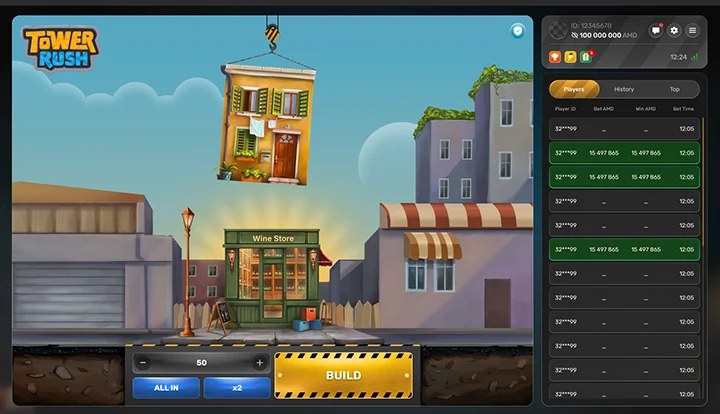
Tower Rush is a crash-style multiplier game. Each round a multiplier climbs while a cash-out decide when to cash out, and the round ends when the tower falls. The RTP is baked into the maths that generate each round’s outcome, so it is spread across thousands of rounds rather than applied to any single one. a cash-out cannot see the RTP working in a short session because normal variance is much larger than the 3 percent edge in the short term.
Tower Rush RTP Facts in India
| Detail | Value | What it means |
|---|---|---|
| Return to Player (RTP) | ~97% | Long-run average payout of staked money |
| House edge | ~3% | The operator’s built-in margin |
| Game type | Crash / multiplier | Cash out before the tower falls |
| Volatility | Medium to high | Frequent small wins, rarer big multipliers |
| Provably fair | Yes | Each round can be verified after it ends |
| Game maker | Galaxsys | Studio behind Tower Rush |
Volatility, Multipliers and Bonus Floors
RTP tells a cash-out the long-run payback, but volatility tells a cash-out how bumpy the ride is. Tower Rush sits in the medium to high band: small wins come often, while large multipliers are rarer. Bonus floors add checkpoint levels that can lock in a minimum return on a round. Bonus floors do not raise the underlying RTP, they change how the same RTP is distributed, giving a cash-out more frequent small protections in exchange for smaller top-end swings.
Tower Rush RTP vs the Real Results
A common mistake is expecting to get back 97 percent in a single session. Short-term results are driven by variance, not by RTP. it is possible to finish a session well above or well below 97 percent purely by chance. RTP only becomes visible across a very large number of rounds. This is why no strategy, signal, or pattern can beat the RTP over time: the edge is fixed in the maths.
Tower Rush Provably Fair: Verify the Math Yourself
Because Tower Rush is provably fair, each round’s outcome can be checked after it ends using the server seed, client seed, and a hash. This does not change the RTP, but it lets a cash-out confirm that results were not altered after a cash-out placed a bet. If a platform hosting Tower Rush does not offer any fairness verification, treat that as a warning sign.
Is a 97 Percent RTP Good for India?
For Indian players comparing crash games, a Tower Rush RTP of about 97 percent is on the favourable side. It is higher than most slots and in line with the better crash titles. That said, RTP is only one factor. Deposit and UPI withdrawal speed, KYC rules, licensing, and responsible limits matter just as much when choosing where to play. Always confirm the exact RTP shown in the game info panel on the platform a cash-out use, since a few operators run configurable versions.
Verified against: Galaxsys Tower Rush game documentation (provider RTP and feature set), Internet Gaming Licence No. ALSI-202606039-F12, and our own cashier terms for deposits, withdrawals and the ₹25,000 welcome pack.
Tower Rush RTP in India: What the Number Covers
RTP is calculated over an enormous number of rounds, not over a session, a day or a month. The figure describes the theoretical share of all wagers that comes back to players across the life of the game, which is why a 96.12-97% band says nothing about any individual round. Tower Rush India reports the range because the exact build used by a given operator can sit at slightly different points inside it, and a provider reference figure can sit at the top of it.
Three things follow from that. First, a short session can land anywhere - well above or well below the theoretical line - without the RTP being wrong. Second, raising the stake does not change the RTP; it only changes the size of each result. Third, chasing a losing run cannot move the maths, because each round is independent of every round before it.
How the House Edge Works Behind Tower Rush
The gap between 100% and the RTP is the house edge, and at a 97% setting that gap is roughly three percent. It is built into the crash-point distribution rather than taken as a fee: the tower collapses earlier, on average, than the multiplier curve alone would suggest. Nothing is subtracted at cash-out and nothing is deducted from a winning round - the edge is already priced in.
That structure is why no staking plan changes the long-run expectation. Doubling after a loss, lowering the stake after a win, or switching between manual and automatic cash-out changes the shape of a session, not its expected value. A flat stake with a fixed auto cash-out target simply makes the outcome easier to predict in advance and easier to live with.
Volatility, Session Length and the RTP Band
Volatility describes how spread out the results are, and in Tower Rush it is largely a function of where the cash-out is set. Targets around 1.30x to 1.50x produce many small, similar results - a lower-variance experience. Targets of 3x and above produce long stretches without a completed round and occasional large results - a higher-variance experience. Both sit on the same RTP line.
Session length matters for the same reason. A short session has a wide spread of possible outcomes around the average, while a long session narrows toward it. This is the single most important practical fact for Indian players using UPI deposits, because it explains why two players can report completely different experiences from the same game in the same week without either being wrong.
Reading the RTP Panel Before Depositing
The figure that matters is the one shown in the game information panel on the platform being used, not a general figure quoted on a comparison page. Before any deposit, the panel is worth opening: it should show the return range, the maximum multiplier, the minimum stake and the maximum win. If a platform cannot show that panel, the game information is incomplete and the deposit is better avoided.
The licence and the provider credit should be visible alongside it. Tower Rush India publishes both - Galaxsys as the game provider and Internet Gaming Licence No. ALSI-202606039-F12 - so that the figures on this guide can be checked against the source rather than taken on trust.
Common RTP Misunderstandings
"Ninety-seven percent means a ninety-seven rupee return on a hundred." It does not. It means that across a very large volume of wagers, roughly ninety-seven percent returns to players collectively. Individual results vary enormously.
"A game that has not paid out is due." It is not. Tower Rush rounds are independent, and a run of early collapses does not raise the chance of a tall tower in the next round.
"A higher RTP guarantees a winning session." It does not. A high-return game can still produce a losing session, and a lower-return game can produce a winning one. RTP shifts the long-run average, not the outcome of any single night.
"Volatility and RTP are the same thing." They are not. RTP sets the average return, while volatility sets how widely results spread around it. Two games with identical RTP can feel completely different to play.
Where Our Tower Rush RTP Figures Come From
The 96.12-97% band reflects how Tower Rush is configured across the India-facing market and how Galaxsys documents the game. The payout formula, the maximum multiplier and the volatility behaviour are taken from the provider's game documentation and from observed rounds in the demo environment. Where a figure varies by build, the range is stated rather than a single number, so that nothing in this guide reads as a promise the platform cannot keep.
A 30% tax applies to online game winnings in India under Sections 115BB and 115BBJ of the Income Tax Act, with TDS on net winnings. Tax treatment depends on individual circumstances and is handled by the payment desk, sitting outside the RTP calculation entirely.
FAQ
What is the Tower Rush RTP?
Tower Rush RTP is commonly listed at about 97 percent, which means roughly a 3 percent house edge over the long run.
Is a 97 percent RTP good?
Yes. A 97 percent RTP is competitive for a crash-style game and higher than many slots, though it is a long-run average, not a promise for any single session.
Does RTP guarantee winnings?
No. RTP is a long-term statistical average measured over millions of rounds. Short sessions can swing far above or below it.
Can the RTP be changed?
The RTP is set by the Galaxsys game maths. Some platforms may run configurable versions, so check the game info panel on the platform a cash-out use.